Yes, stainless steel jewelry is excellent quality—when it’s made from 316L surgical-grade steel. This material is tarnish-proof, hypoallergenic, and the exact same metal luxury brands use for their $800+ chains. The only difference? Markup.
There’s a persistent misconception that stainless steel jewelry is “cheap” or “low quality.” This confusion stems from people associating stainless steel with cookware or fast-fashion jewelry made from inferior alloys. High-grade stainless steel (specifically 316L) is one of the most durable, skin-safe materials available for daily wear.
In this guide, you’ll learn the material science behind why 316L stainless steel outperforms silver and gold-plated options for everyday jewelry, how to identify quality pieces, and why this metal has become the go-to choice for men who want lasting style without the luxury markup.
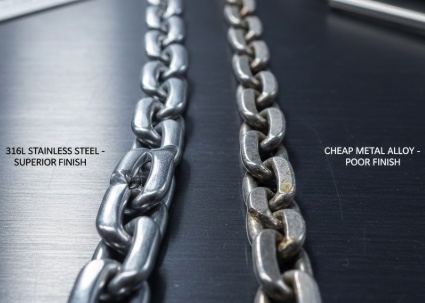
Yes, Stainless Steel Jewelry Is Good Quality
Stainless steel jewelry—when crafted from 316L grade—delivers professional-grade quality that rivals precious metals. This isn’t an opinion; it’s material fact.
316L stainless steel is surgical-grade metal. Hospitals use it for medical implants because it won’t corrode inside the human body. Luxury watch brands like Rolex use it for their cases and bracelets. High-end jewelry designers charge $500-$1,200 for 316L chains identical in composition to pieces priced at $120-$180 from direct-to-consumer brands.
Here’s what makes 316L stainless steel objectively good:
- Tarnish-proof: Will not oxidize or change color over time
- Hypoallergenic: Contains minimal nickel (safe for sensitive skin)
- Corrosion-resistant: Withstands water, sweat, chlorine, and saltwater
- Durable: Scratch-resistant and maintains structural integrity for decades
- Low-maintenance: Requires zero polishing or special care
- Evergreen finish: Looks identical on day 1 and day 1,000
The quality question isn’t whether stainless steel is “good enough.” It’s whether you’re willing to pay 300-500% more for precious metals that require constant upkeep and offer no functional advantage for daily wear.
What Makes 316L Stainless Steel Good for Jewelry
The “L” in 316L stands for “low carbon”—a technical detail that changes everything about how this metal performs.
316L stainless steel contains iron, chromium (16-18%), nickel (10-14%), and molybdenum (2-3%). The low carbon content (0.03% maximum) prevents chromium carbide precipitation, which is the technical way of saying it won’t develop weak spots that corrode over time.
Why this composition matters:
The chromium creates a passive oxide layer on the surface. This invisible barrier regenerates automatically when scratched, making the metal self-healing against corrosion. Molybdenum adds resistance to chloride environments (saltwater, pool chlorine, sweat). The low carbon prevents sensitization—a process where heat exposure creates corrosion-prone zones along grain boundaries.
Lower-grade stainless steels (304, 201) skip the molybdenum or use higher carbon content. They cost less to produce but fail faster. You’ll see oxidation around clasps, discoloration in crevices, and eventual structural breakdown. That’s where stainless steel’s “cheap” reputation comes from—people experiencing failures from inferior alloys that went through the wire.
316L vs Lower Grades:
| Feature | 316L Stainless | 304 Stainless | 201 Stainless |
|---|---|---|---|
| Corrosion Resistance | Excellent | Good | Poor |
| Saltwater Safe | Yes | Limited | No |
| Chlorine Resistance | Yes | Limited | No |
| Nickel Content | 10-14% | 8-10% | 1% (unstable) |
| Common Use | Medical implants, marine hardware, jewelry | Food processing | Fast fashion |
| Lifespan in Jewelry | Lifetime | 5-10 years | 1-2 years |
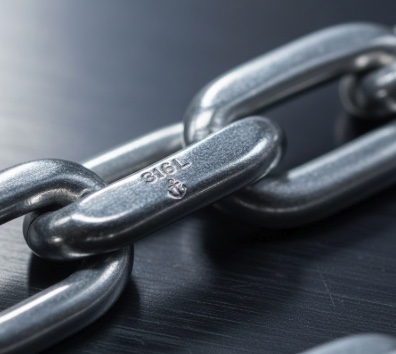
When jewelry brands don’t specify the grade of stainless steel they use, assume it’s not 316L. Quality manufacturers advertise this detail because it’s a selling point.
Stainless Steel vs Silver vs Gold: The Real Comparison
Let’s compare 316L stainless steel against sterling silver and gold-plated jewelry using real-world performance, not marketing language.
| Factor | 316L Stainless Steel | Sterling Silver (925) | Gold Plated (Base Metal) |
|---|---|---|---|
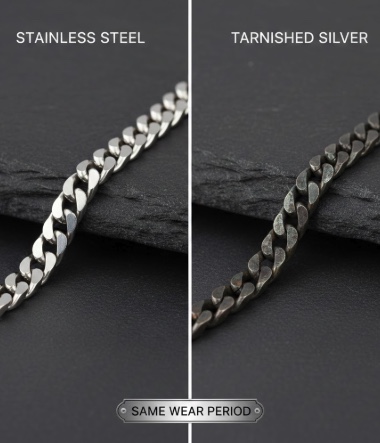
| Tarnish Resistance | Never tarnishes | Tarnishes regularly | Base metal shows through in 6-18 months |
| Water Safe | Shower, pool, ocean safe | Tarnishes faster when wet | Plating degrades rapidly |
| Maintenance | Wipe with cloth | Polish monthly, use anti-tarnish solutions | Re-plate every 1-2 years |
| Hypoallergenic | Yes (low nickel) | Yes (if genuine 925) | No (base metal often nickel/copper) |
| Scratch Resistance | High | Low (soft metal) | Low (plating scratches easily) |
| Weight | Substantial | Light (unless solid) | Varies (often hollow) |
| Lifespan | Lifetime | 10-20 years with care | 1-3 years maximum |
| Cost (Chain) | $100-$200 | $150-$400 | $30-$80 |
| Resale Value | Material value only | Silver spot price | None |
Maintenance Reality:
Sterling silver requires anti-tarnish strips in storage, regular polishing with specific cleaners, and removal before water exposure. You’ll spend 15-30 minutes monthly maintaining each piece.
Gold-plated jewelry looks great initially but degrades predictably. The micron-thin gold layer (typically 0.5-2.5 microns) wears through at contact points: clasps, links that rub together, anywhere the piece bends repeatedly. Re-plating costs $40-$100 per piece and requires sending items to jewelers for weeks.
316L stainless steel requires literally zero maintenance. Wear it in the shower. Sleep in it. Work out in it. Rinse it off occasionally if it gets dirty. That’s the entire care routine.
Cost vs Longevity Verdict:
A $150 stainless steel chain worn daily for 20 years costs $7.50 per year. A $300 silver chain requiring maintenance supplies and eventual replacement costs $20-$30 annually. A $60 gold-plated chain replaced every 18 months costs $40 per year.
For daily wear jewelry, stainless steel delivers the best value by a significant margin.
Why Stainless Steel Gets a Bad Reputation
If 316L stainless steel performs this well, why do some people still consider it “cheap” jewelry?
Confusion with inferior alloys: Most people’s experience with “stainless steel jewelry” comes from $15 pieces on Amazon or fast-fashion retailers. These use 201 or 304 grade steel (or worse—unmarked mystery alloys from unregulated manufacturing). When these pieces turn your skin green or corrode within months, the blame falls on “stainless steel” generally rather than the specific grade.
Fast-fashion metals: Major retailers selling jewelry for $10-$40 rarely use real 316L stainless steel. The material cost alone would eliminate their profit margins. They use plated brass, zinc alloy, or low-grade stainless, then market everything as “stainless steel” because there’s no consumer regulation requiring grade disclosure.
Marketing bias toward precious metals: The jewelry industry spent a century building cultural associations between “valuable” and “gold/silver/platinum.” Diamonds are marketed as rare despite massive global supplies. Pearls command premium prices after being cultured in farms. The perception of value often has little connection to actual material performance or scarcity—what people say about materials rarely reflects reality.
Stainless steel doesn’t have this marketing mythology. It’s honest about what it is: engineered metal optimized for real-world durability. For an industry built on perceived luxury, that transparency is almost threatening.
The bias is starting to shift. Younger buyers (especially men aged 24-35) prioritize quality and value over traditional luxury signaling. They research materials, compare specs, and make informed decisions. That’s why brands using 316L stainless steel and transparent pricing are growing rapidly while traditional jewelers struggle.
Common Questions, Straight Answers
Is stainless steel jewelry safe to wear?
Yes. 316L surgical-grade stainless steel is biocompatible—safe enough for medical implants. The nickel content (10-14%) is bound within the alloy structure and doesn’t leach out. People with severe nickel allergies occasionally react, but it’s rare compared to costume jewelry, which often has free nickel in base metals.
Will stainless steel jewelry tarnish or turn green?
No. Tarnishing occurs when metals oxidize (react with oxygen). The chromium oxide layer on 316L stainless steel prevents oxidation completely. Your skin won’t turn green, and the metal won’t change color. This applies even after years of daily wear, including exposure to water and sweat.
Can you shower in stainless steel jewelry?
Absolutely. Water, soap, shampoo, and body wash won’t damage 316L stainless steel. Ocean water and chlorinated pools are also fine. This is one of stainless steel’s biggest practical advantages over silver (which tarnishes faster when wet) and gold-plated pieces (where water accelerates plating degradation).
How long does stainless steel jewelry last?
Indefinitely with normal wear. The metal doesn’t degrade, corrode, or lose structural integrity over time. Your only replacement concern would be losing a piece or wanting a style change. Twenty-year-old 316L stainless steel jewelry looks and performs identically to new pieces. What doesn’t break you makes you stronger—and 316L simply doesn’t break.
Does stainless steel look cheap?
High-quality 316L stainless steel, properly finished and polished, is visually indistinguishable from white gold or platinum. The “cheap” look comes from poor finishing (visible seams, rough edges, inconsistent polish) or lightweight hollow construction—manufacturing choices, not material limitations. Well-crafted stainless steel jewelry has the weight, finish, and appearance of premium pieces.[BUTTON: ” →”]
How to Identify Quality Stainless Steel Jewelry
Not all stainless steel jewelry is created equal. Here’s how to separate quality pieces from cheap alternatives before you buy.
Look for explicit 316L labeling: Reputable brands stamp “316L” or “surgical steel” on their pieces (usually near the clasp or on a small tag). If the product description just says “stainless steel” without specifying the grade, it’s probably not 316L. Brands using premium materials advertise this fact.
Check the weight: Quality stainless steel jewelry has substantial weight. Pick it up—it should feel solid, not hollow or flimsy. A 6mm Cuban chain in 316L stainless steel should weigh 40-60 grams for a 20-inch length. Anything significantly lighter is either hollow (weaker construction) or made from a lighter alloy.
Examine clasp construction: The clasp is the failure point on most jewelry. Quality 316L pieces use reinforced lobster clasps with secure closures and smooth operation. Cheap jewelry uses spring ring clasps (circular clasps that pinch open) or flimsy lobster clasps that feel loose. Test the clasp several times—it should click shut securely without gaps.
Verify warranties: Brands confident in their materials offer lifetime warranties against tarnishing, fading, and structural defects. Short warranties (30-90 days) or no warranty at all signal that the manufacturer expects the jewelry to fail. Quality 316L stainless steel should be guaranteed for years, if not indefinitely.
Price reality check: Genuine 316L stainless steel jewelry typically costs $80-$250 for chains, depending on style and weight. Prices under $40 usually indicate lower-grade steel or hollow construction. Prices over $400 from luxury brands often reflect markup rather than material differences—you’re paying for the name, not superior metal.
Why VEYRO Uses 316L Stainless Steel
VEYRO exclusively uses 316L surgical-grade stainless steel for all chains and bracelets. This isn’t a budget decision—it’s a quality decision.
We source the same 316L stainless steel that luxury brands use for their $600-$1,200 chains. The difference isn’t material quality. It’s markup. Traditional jewelry retail adds 300-500% margins through wholesale, retail, and brand positioning costs. Direct-to-consumer manufacturing eliminates those middlemen.
Every VEYRO piece is:
- Certified 316L stainless steel (stamped and verified)
- Solid construction (no hollow pieces that weaken over time)
- Professionally finished (hand-polished to remove imperfections)
- Substantial weight (60+ grams for standard chains)
- Lifetime warranty (we guarantee it won’t tarnish, fade, or corrode)
The pricing is straightforward. A 6mm Cuban chain costs us approximately $45-$65 to manufacture with 316L steel, quality finishing, and secure clasps. We sell it for $139-$179. That’s a transparent margin on quality materials. Compare that to luxury brands charging $800-$1,200 for chemically identical chains—new watches, new chains, same old markup game.
We use 316L stainless steel because it’s objectively the best material for everyday men’s jewelry. It performs better than silver, costs less than gold, and lasts longer than both. When you remove luxury markup from the equation, the choice becomes obvious.
The Bottom Line: Is Stainless Steel Jewelry Good?
Yes—if it’s 316L surgical-grade stainless steel.
This material is tarnish-proof, hypoallergenic, water-safe, and built to last decades with zero maintenance. It’s the same metal used in medical implants and luxury watch cases. The performance is proven. The chemistry is understood.
Stainless steel jewelry is ideal for:
- Daily wear pieces you never want to remove
- Active lifestyles (gym, swimming, outdoor activities)
- Anyone who wants quality without constant maintenance
- Guys building their first jewelry collection
- Anyone tired of overpaying for luxury brand names
The “cheap” reputation comes from inferior grades and fast-fashion manufacturing, not from the material itself. When you choose 316L stainless steel from a transparent brand, you’re getting professional-grade quality at an honest price.
Quality jewelry doesn’t require luxury markups. It requires quality materials and honest pricing. The best materials speak for themselves—no hype needed.
Shop VEYRO’s 316L stainless steel collection—lifetime warranty, transparent pricing, built to last.